WHY TYCHOS?
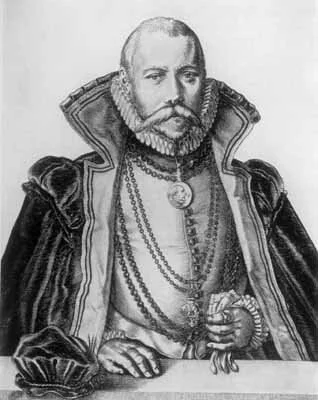
Tychos is named in honor of Tycho Brahe (1546–1601), the Danish astronomer known for “his comprehensive and unprecedentedly accurate astronomical observations which helped to turn astronomy into the first modern science and launch the Scientific Revolution.” Tycho accepted an offer from King Frederick II to fund an observatory, was given the little island of Hven in the Sont near Copenhagen, and there he built his observatory, Uraniburg, which became the finest observatory in Europe. Tycho designed and built new instruments, calibrated them, and instituted nightly observations. He also ran his own printing press. The observatory was visited by many scholars, and Tycho trained a generation of young astronomers there in the art of observing.
Tycho Brahe's contributions to astronomy were enormous. He not only designed and built instruments, he also calibrated them and regularly checked their accuracy, thus revolutionizing astronomical instrumentation. He also profoundly changed observational practice. Whereas earlier astronomers had been content to observe the positions of planets and the Moon at certain important points of their orbits, Tycho and his assistants observed these bodies throughout their orbits. As a result, a number of orbital anomalies never before noticed were made explicit by Tycho. Without this complete series of observations of unprecedented accuracy, Kepler could not have discovered that planets move in elliptical orbits. Tycho was also the first astronomer to make corrections for atmospheric refraction. In general, whereas previous astronomers made observations accurate to perhaps 15 arc minutes, those of Tycho were accurate to perhaps 2 arc minutes, and it has been shown that his best observations were accurate to about half an arc minute.
Tycho was the bridge from the work of Nicolaus Copernicus (1473–1543) the Polish astronomer who formulated the comprehensive heliocentric model, placing the Sun at the center of the universe—to Johannes Kepler (1571–1630) the German mathematician and astronomer who used Brahe’s data to discover the three fundamental laws of planetary motion, (Sir Isaac Newton, 1643–1727, was the English polymath who, challenged by Kepler’s laws, formulated the law of universal gravitation explaining the physics behind them), and Galileo Galilei (1564–1642) the Italian physicist and astronomer who made pioneering telescopic discoveries, including the moons of Jupiter and the phases of Venus.